This is the bridge between data and riding: how to take a LapBrain recommendation and turn it into real improvement on the motorcycle.
The problem with information overload
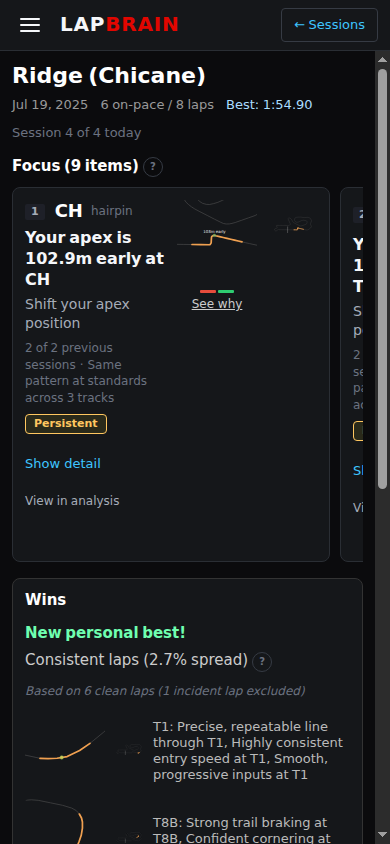
A long list is hard to remember on track. LapBrain ranks its Focus recommendationFocus recommendationThe corner or riding pattern LapBrain puts forward for you to review next. s so you can choose one manageable item instead of trying to carry the whole debrief at once.
Before your session: brief
Open your last debrief (menu → Sessions, tap the session, then Debrief) and write down three things:
- Which area: the named corner, complex, or straight
- Which measurement or technique: braking, line, throttle, or Trail brakingTrail brakingKeeping some brake pressure applied as the motorcycle begins changing direction into a corner.
- What to check or change: use the wording from the focus item
Write it on tape on your tank, in your phone, or wherever you'll see it before you ride. Keep the note short enough to remember on track.
During your session: focus
Fit the focus item around the session plan and instructions from the organizer or your coach:
- Re-read the item's Why and Check before the session.
- Try only changes that make sense for the track conditions, traffic, flags, and your experience.
- Keep the check scoped to the named corner or straight rather than generalizing it everywhere.
Lap time alone cannot tell you whether a change is safe or appropriate. Follow flags, event rules, your own judgment, and any coach or organizer instruction ahead of an app recommendation. Stop testing a change if it does not feel safe or the conditions no longer match.
After your session: debrief
Upload while the session is fresh in your memory, which makes the debrief easier to act on. Then check:
- What happened to the Coaching threadCoaching threadAn issue followed across comparable sessions, such as entry-speed spread at T5 or section-time spread through the esses. ? Read its latest status and measurement in the debrief or track history.
- Where did corner time change? Read the delta beside the laps and channels it names.
- What changed downstream? Compare the following corner or straight when the time gap continues beyond the focus area.
Reading the list
Your debrief's focus section is one list. Read it top to bottom and stop wherever you run out of session. Every entry is tagged so you can see what kind of thing it is:
- Numbered entries (1, 2, 3…) come first. A number means the recommendation is complete: it names what to change, where, and how the next session checks it. Some numbered entries come from a detected pattern worth fixing; others build on something your own best lap already demonstrated. The entry's wording tells you which.
- "Practice" entries come last. These are measured references from your own riding: a lap worth repeating, or a corner where your own best lap was faster than your usual.
Every entry uses the same compact structure:
- A badge or a number, so you know what kind of entry it is.
- The corner or straight it's about.
- A measured local payoff above the map when the entry builds on something your own lap demonstrated.
- A proof visual: numbered recommendations use a full-size comparison map with the named lap paths and measured points. A Practice entry may use a compact corner locator when no honest lap comparison exists.
- One line with the action to try or measurement to review.
- At most one comparison number separate from any demonstration payoff.
When a numbered recommendation has no lap to compare against, it says so.
Tap an entry to open it. That's where the rest lives: the measurement backing the advice, the riding principle it rests on, and exactly how your next session checks whether it worked.
For an entry built on your own demonstration, the measured local payoff stays visible above the comparison map. The tap layer holds Why (your own measurement, plus the riding principle) and Check (how the next comparable session verifies it, typically three clean comparable laps). The payoff is corner time from your laps, labeled by where it came from.
The follow-up is the point. When the same measurement is available, your next debrief at that track shows Follow-up measurements: whether the earlier pattern moved in the suggested direction, stayed about the same, or still shows room. You add the context about whether you acted on the advice.
Common recommendations and how to practice them
| Recommendation | What it means | How to practice |
|---|---|---|
| "Smoother brake release" | Recorded brake data shows a repeatable release-shape difference | Review the named reference and the item's Check line; use coach guidance for the riding change. |
| "Trail brake longer" | Recorded brake data supports a release-timing comparison | Keep the test at the named corner and within a technique plan you have agreed with your coach. |
| "Steadier apex speed" | Minimum speed varied across comparable laps | Compare the line and the speed channel without treating one lap as an automatic target. |
| "Cleaner exit drive" | Recorded throttle and speed show an exit-timing difference | Review the named exit and the item's Check line, then apply it only where conditions and guidance allow. |
What to do next
- Open your latest debrief and note your focus recommendation.
- Write it down using the three-part format: area, measurement or technique, check or change.
- Read Track Preparation for how to build a full pre-session plan.